Negotiate from the weaker side. Win on discipline.
Most small business owners are outgunned at every table they sit at - larger customers, better-funded banks, more experienced landlords, lawyers paid by the hour to win at their expense. Outgunned is the field manual they were never given.
The frameworks weren't built for your kitchen table at 9:47 p.m.
Harvard's "Getting to Yes." Tactical books from former hostage negotiators. Venture-style dealmaking. Each tradition is useful. None of them was written for the owner-operator who has to read a forty-seven-page MSA, negotiate a line-of-credit renewal, and respond to a foreman's outside offer - in the same week, with no analyst team, no general counsel, and the mortgage on the line.
Outgunned closes that gap. It is a working manual built on the structural realities of small business deal-making - asymmetry, volatility, overload, and relational risk - and the discipline that compounds across a career into enduring wealth.
Practical capability, not theoretical fluency.
Read any contract - and know what to fight for
Identify the ten clauses that quietly cost small businesses the most money: indemnification, limitation of liability, personal guarantees, auto-renewal, MFC, termination for convenience, change of control, exclusivity, non-compete, and waiver of jury trial. Know which to push, which to accept, and exactly when to call counsel.
Prepare under load
Run the three-perspective framework, build a one-page pre-negotiation worksheet, and triage when twelve things compete for your attention at once.
Find your hidden leverage
Use the six levers smaller operators actually have - speed, access, specialization, switching costs, optionality, and relationship capital - to negotiate as the smaller party with discipline.
Govern partners and family
Design the buy-sell agreement most operators avoid until it's too late. Untangle the three negotiations inside every family business.
Handle capital like a principal
Negotiate banking relationships, SBA programs, growth capital, and the difference between a useful private equity recap and an expensive one.
Build a lifetime practice
Convert tactics into a personal theory of practice - the discipline that turns better deals, repeated, into the compounded difference between surviving and building wealth.
"The compound effect of better deals, repeated across a career, is the difference between an operator who survives and an operator who builds enduring wealth." - From the Conclusion
For the operator at the table.
This book is written for the people who actually carry the risk - the owner-operators, the partner-managers, the second-generation principals, the founder-operators of services firms, restaurants, manufacturers, contractors, and trades businesses.
If you have ever signed a personal guarantee, lost sleep over a contract clause you didn't fully understand, or wondered whether you were being slow-played by a procurement officer with a deadline you couldn't see - this manual was built for you.
More about the book →- Owner-operators of 5-250 person companies
- Family business principals and successors
- Trade and construction firm owners
- Professional services partners
- Searchers and acquisition-minded buyers
- Fractional executives and operating partners
- Trade association leaders and member advisors
- Business school students of entrepreneurship
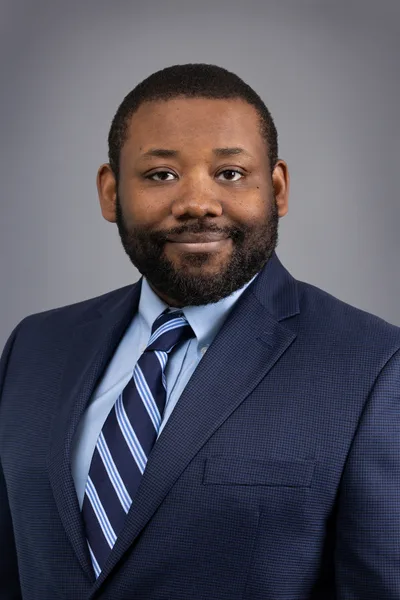
Jelani Ellington, PhD
Operator, scholar, and trade association executive who has spent his career working both sides of the negotiation table - from Fortune 50 P&Ls to 300-member trade association advocacy.
Dr. Ellington has held executive roles with P&L responsibility up to $11 billion at Elevance Health, Capital One, Walmart, General Motors, and Ford. He currently serves as Chief Operating Officer of a 135-year-old commercial construction trade association representing more than 300 member companies, and runs Innovatus, a consulting firm providing fractional executive services and AI adoption training to small and mid-sized firms.
Read his full bio →